VRM phases for Ryzen CPUs: how many are enough?
AMD Ryzen 5800X3D, 5900X, and 5950X processors are still relevant. The AM4 platform still has a wide range of motherboards, including those based on the X570S, X570, and B550 chipsets.

As experience shows, VRM manufacturers cannot do without multi-phase designs. Increasing the number of phases increases total current and power delivery and helps stabilize voltage. The purpose of power phases is to convert the input voltage into exactly the level required for the processor to operate.
This article explains how many power phases are required for the Ryzen 5600X, 5800X3D, and 5900X processors. In most cases, the number of phases specified by manufacturers is mostly marketing. Phases are labeled A + B, where A refers to the CPU core power phases and B to integrated graphics and memory. The “×2” symbol indicates the use of doublers…
Table of contents:
General understanding of Power Phases
The VRM power delivery system is a system of components on the motherboard. It converts the high voltage from the power supply unit (usually 12 V) into a lower voltage required by the processor (around 1–1.5 V). The CPU also requires a high current draw, which can reach tens of amperes.
It includes the PWM controller itself, MOSFETs, inductors, and capacitors. The PWM controller determines how much power needs to be delivered to the CPU. The other components perform regulation and signal filtering functions. The wider the pulses are, the higher the current supplied…
Each power phase delivers power to the processor. It is a circuit made up of capacitors, inductors, and transistors that must operate in synchrony. The more true power phases there are, the more stable and cleaner the output voltage will be.
How much power do Ryzen CPUs consume?
The thermal design power (TDP) of the Ryzen 9 5950X is rated at 105 W, but its power limit is set to 142W. In practice, when boosting up to 4.6 GHz, power consumption rises to 231 W. Under a heavy Cinebench R23 load, the current draw reaches 163 A at a voltage of 1.42 V.
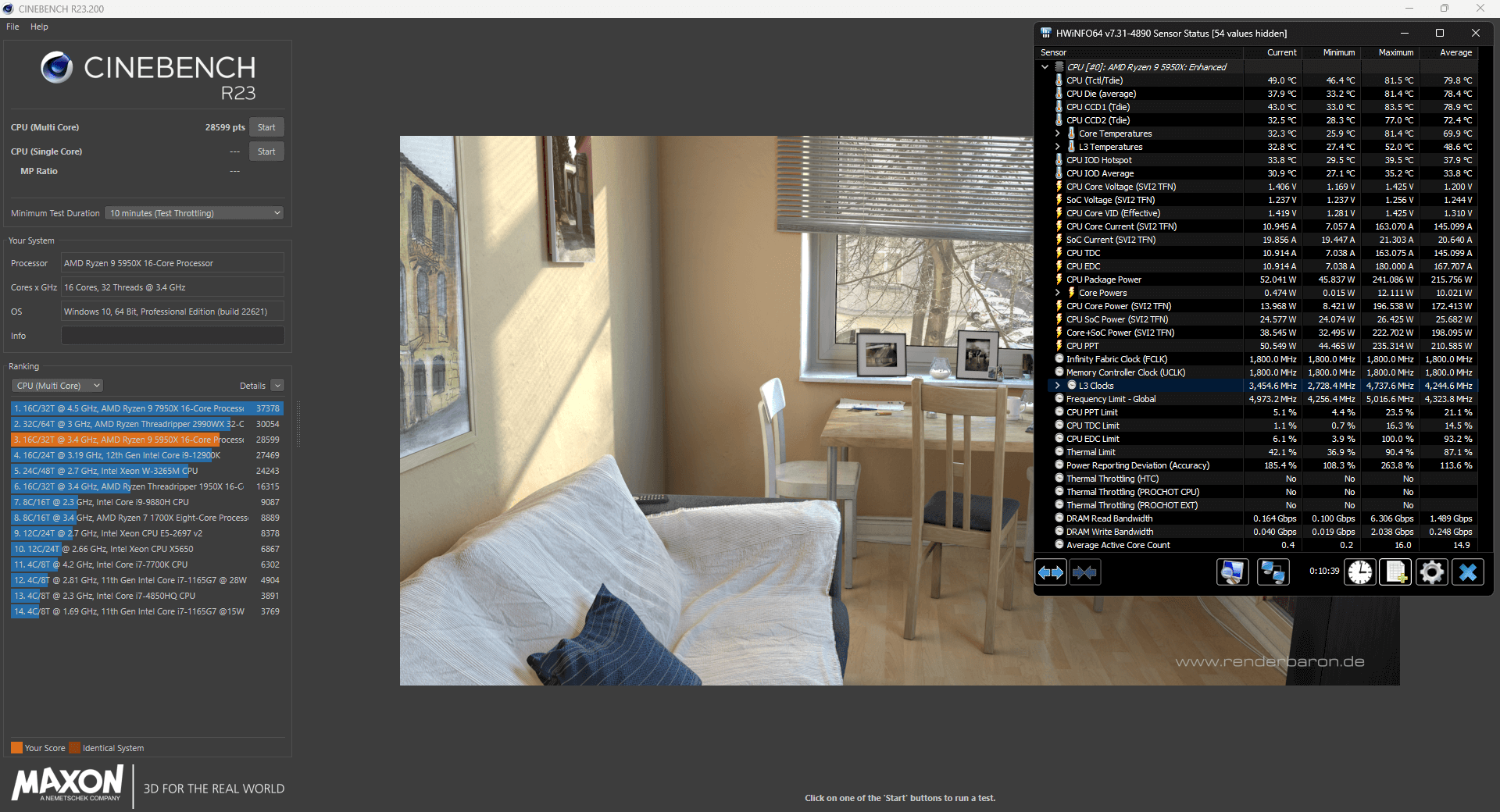
All processors have already been extensively tested. You can find power consumption data for any of them. This value may vary depending on load, frequency, and voltage settings. It is important to note that overclocking and stress testing are indeed extreme operating conditions…
VRM real-world performance and limits
For example, the GIGABYTE X570S AORUS MASTER motherboard features an updated VRM design. It has a 14+2 phase power delivery design, and the XDPE132G5C PWM controller can control all 16 phases. It is equipped with Infineon TDA21472 MOSFETs, rated at up to 70 A.
In the technical specifications of this MOSFET, we need to examine the operating characteristics. We are interested in the current vs. temperature graph (Fig. 5). The rated 70 A can only be achieved at sub-zero temperatures. At 60 °C, it provides approximately 50 A, which gives 14 phases × 50 A = 700 A.
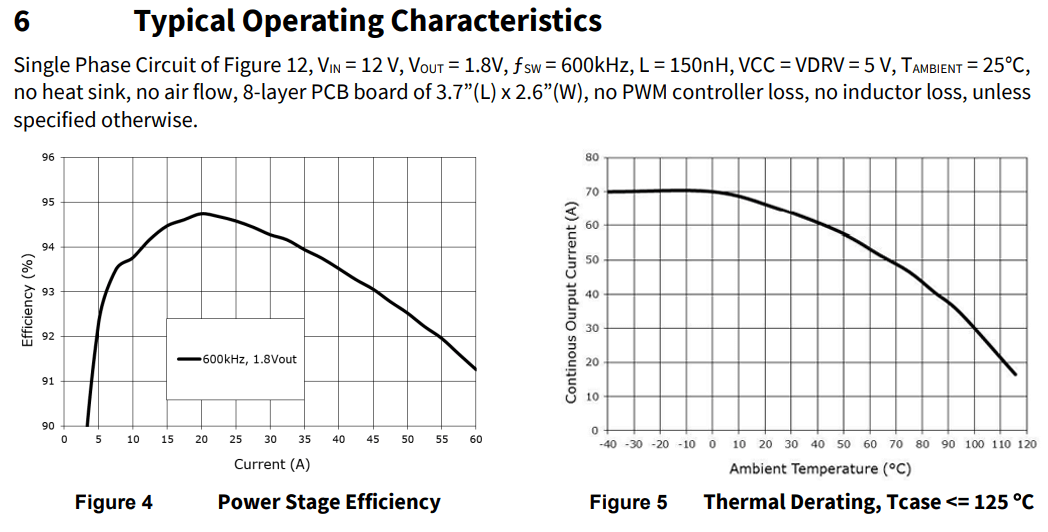
The efficiency graph (Fig. 4) shows that at a current of 50 — 55 A, efficiency is about 92%. Theoretically, this configuration corresponds to 700 A × 92% = 644 A to the CPU. In practice, temperatures are higher, meaning the maximum possible load is even lower. These are real phases without doublers…
How many power Phases are required for Ryzen 5000?
For 12- and 16-core CPUs (200+ W), 6 phases (minimum 40 A) with doublers are required. 8-core CPUs (up to 150 W) require 5 phases (minimum 50 A) with a doubler or DualOut configuration. 6-core CPUs (75 W) require at least 4 actual phases. Please refer to the table, as 6 power phases using 50 A and 90 A MOSFETs are not the same thing.
| We won’t focus on current draw. CPU power consumption alone is more than enough for our purposes. The full version of the TABLE includes more data. CPU power consumption: 200 W: 3950X OC, 5900X OC, 5950X OC; 175 W: 5800X OC, 3950X, 5900X, 5950X; 150 W: 2700X OC, 3800X OC, 5800X, 3900X; 125 W: 3600X OC, 2700X, 3800XT, 5800X3D; 100 W: 5600X, 3700X, 3800X и 5700X. |
+ | Will work without any issues. Fully compatible. |
| * | Airflow is essential, though it will run fine under light loads. | |
| ** | Strong airflow is recommended, otherwise high VRM temperatures may occur. | |
| – | Not recommended. Compatible only on paper. Expect overheating and throttling. |
Table 1. X570 and X570S motherboard VRM ratings
It indicates how many phases are required for Ryzen CPUs, taking VRM capabilities into account. In practice, a 6-phase power delivery system is more than enough. Such setups typically feature high-quality VRM cooling. A 6 × 2 configuration (50A with doublers) allows the Ryzen 9 5950X to be overclocked comfortably.
| Model | 200 | 175 | 150 | 125 | Phases | Mosfet (SPS) | |
| ASRock X570 AQUA | + | + | + | + | 6×2 | Doubler | 1x IR3555 60A |
| ASRock X570 Creator | + | + | + | + | 6×2 | Doubler | 1x IR3555 60A |
| ASRock X570 Taichi Razer Edition | + | + | + | + | 7×2 | Doubler | 1x SiC634 50A |
| ASRock X570 Taichi | + | + | + | + | 6×2 | Doubler | 1x SiC634 50A |
| ASRock X570 Extreme4 WiFi ax | ** | * | + | + | 4×2 | Doubler | 1x SiC632A 50A |
| ASRock X570 Pro4 | – | ** | * | + | 4×2 | Doubler | SM4336/4337[1×1] |
| ASRock X570M Pro4 | – | ** | * | + | 4×2 | Doubler | SM4336/4337[1×1] |
| ASRock X570 Steel Legend WiFi ax | ** | * | + | + | 4×2 | Doubler | 1x SiC632A 50A |
| ASRock X570 PG Velocita | + | + | + | + | 6×2 | Doubler | 1x SiC634 50A |
| ASRock X570S PG Riptide | * | * | + | + | 4 | DualOut | 2x SiC654 50A |
| ASRock X570 Phantom Gaming X | + | + | + | + | 6×2 | Doubler | 1x SiC634 50A |
| ASRock X570 Phantom Gaming 4 WiFi ax | – | ** | * | + | 4×2 | Doubler | SM4336/4337[1×1] |
| ASRock X570 Phantom Gaming 4S | – | – | ** | * | 3×2 | Doubler | SM4336/4337[2×2] |
| ASRock X570 Phantom Gaming-ITX/TB3 | – | ** | * | + | 4×2 | Doubler | 1x ISL99227 60A |
| ASUS ROG Crosshair VIII Formula | + | + | + | + | 7 | DualOut | 2x IR3555 60A |
| ASUS ROG Crosshair VIII Hero (WI-FI) | + | + | + | + | 7 | DualOut | 2x IR3555 60A |
| ASUS ROG Crosshair VIII Impact | * | * | + | + | 4 | DualOut | 2x TDA21472 70A |
| ASUS ROG Strix X570-E Gaming | + | + | + | + | 6 | DualOut | 2x IR3555 60A |
| ASUS ROG Strix X570-F Gaming | * | * | + | + | 4 | TripleO | 3x SiC639 50A |
| ASUS ROG Strix X570-I Gaming | * | * | + | + | 4 | DualOut | 2x TDA21472 70A |
| ASUS PRIME X570-PRO/CSM | * | * | + | + | 4 | TripleO | 3x SiC639 50A |
| ASUS TUF GAMING X570-PLUS (WI-FI) | * | * | + | + | 4 | TripleO | 3x SiC639 50A |
| ASUS PRIME X570-P | ** | * | * | + | 4 | DualOut | 2x SiC639 50A |
| ASUS TUF GAMING X570-PRO (WI-FI) | + | + | + | + | 7 | DualOut | 2x SiC639 50A |
| ASUS ROG Crosshair VIII Dark Hero | + | + | + | + | 7 | DualOut | 2x X95410RR 90A |
| ASUS ROG CROSSHAIR VIII EXTREME | + | + | + | + | 9 | DualOut | 2x X95410RR 90A |
| ASUS ROG STRIX X570-E GAMING WIFI II | + | + | + | + | 7 | DualOut | 2x FDMF3170 70A |
| ASUS ProArt X570-CREATOR WIFI | + | + | + | + | 7 | DualOut | 2x FDMF3170 70A |
| ASUS TUF GAMING X570-PRO WIFI II | * | + | + | + | 6 | DualOut | 2x SiC639 50A |
| ASUS Pro WS X570-ACE | * | + | + | + | 6 | DualOut | 2x IR3555 60A |
| BIOSTAR Racing X570GTA | – | ** | * | * | 4 | DualOut | SM4364/4377[1×2] |
| BIOSTAR Racing X570GT | – | ** | ** | * | 4 | True | SM4364/4377[2×1] |
| BIOSTAR Racing X570GT8 | * | * | + | + | 4 | Doubler | 1x IR3555 60A |
| Colorful CVN X570 Gaming PRO V14 | – | ** | * | + | 4 | DualOut | AON6354/6414A |
| Colorful CVN X570M Gaming PRO V14 | – | ** | ** | * | 4 | DualOut | AON6354/6414A |
| Colorful CVN X570M Gaming Frozen V14 | – | ** | ** | * | 4 | DualOut | AON6354/6414A |
| EVGA X570 DARK | + | + | + | + | 7×2 | Doubler | 1x ISL99390 90A |
| EVGA X570 FTW WIFI | + | + | + | + | |||
| GIGABYTE X570SI AORUS PRO AX | * | * | + | + | 4 | DualOut | 2x ISL99390 90A |
| GIGABYTE X570S AORUS PRO AX | + | + | + | + | 6 | DualOut | 2x IR3555 60A |
| GIGABYTE X570S AORUS MASTER | + | + | + | + | 14 | True | 1x TDA21472 70A |
| GIGABYTE X570S AERO G | + | + | + | + | 6 | DualOut | 2x IR3555 60A |
| GIGABYTE X570 AORUS XTREME | + | + | + | + | 14 | True | 1x TDA21472 70A |
| GIGABYTE X570 AORUS MASTER | + | + | + | + | 12 | True | 1x IR3556 50A |
| GIGABYTE X570 AORUS ULTRA | + | + | + | + | 6×2 | Doubler | 1x IR3553 40A |
| GIGABYTE X570 AORUS PRO WIFI | + | + | + | + | 6×2 | Doubler | 1x IR3553 40A |
| GIGABYTE X570 UD | – | ** | * | + | 5×2 | Doubler | 4C06N/4C10N[2×1] |
| GIGABYTE X570 GAMING X | – | ** | * | + | 5×2 | Doubler | 4C06N/4C10N[2×1] |
| GIGABYTE X570I AORUS PRO WIFI | ** | ** | * | + | 6 | True | 1x TDA21472 70A |
| GIGABYTE X570 AORUS ELITE WIFI | * | + | + | + | 6×2 | Doubler | 1x SiC634 50A |
| GIGABYTE X570S AORUS ELITE AX | + | + | + | + | 6 | DualOut | 2x IR3555 60A |
| GIGABYTE X570S UD | * | * | + | + | 6 | DualOut | 2x SiC651C 50A |
| GIGABYTE X570S GAMING X | * | * | + | + | 6 | DualOut | 2x SiC651C 50A |
| MSI MEG X570S ACE MAX | + | + | + | + | 16 | True | 1x TDA21490 90A |
| MSI MPG X570S EDGE MAX WIFI | + | + | + | + | 6 | DualOut | RAA220075R0 75A |
| MSI MEG X570S UNIFY-X MAX | + | + | + | + | 16 | True | 1x TDA21490 90A |
| MSI MPG X570S CARBON EK X | + | + | + | + | 7 | DualOut | RAA220075R0 75A |
| MSI MPG X570S CARBON MAX WIFI | + | + | + | + | 7 | DualOut | RAA220075R0 75A |
| MSI MAG X570S TOMAHAWK MAX WIFI | + | + | + | + | 6 | DualOut | 2x ISL99360 60A |
| MSI MAG X570S TORPEDO MAX | + | + | + | + | 6×2 | Doubler | 1x ISL99360 60A |
| MSI MAG X570 TOMAHAWK WIFI | + | + | + | + | 6×2 | Doubler | 1x ISL99360 60A |
| MSI MEG X570 UNIFY | + | + | + | + | 6×2 | Doubler | 1x IR3555 60A |
| MSI X570-A PRO | – | ** | * | + | 4×2 | Doubler | 4C024N/4C029N |
| MSI MPG X570 Gaming Pro Carbon WIFI | – | * | + | + | 5×2 | Doubler | 1x QA3111N6N |
| MSI MPG X570 GAMING EDGE WIFI | – | ** | * | + | 4×2 | Doubler | 4C024N/4C029N |
| MSI PRESTIGE X570 CREATION | + | + | + | + | 7×2 | Doubler | 1x IR3555 60A |
| MSI MEG X570 GODLIKE | + | + | + | + | 7×2 | Doubler | 1x TDA21472 70A |
| MSI MEG X570 ACE | + | + | + | + | 6×2 | Doubler | 1x IR3555 60A |
| MSI MPG X570 GAMING PLUS | – | ** | * | + | 4×2 | Doubler | 4C024N/4C029N |
Table 2. B550 motherboard VRM ratings
Following the X570 chipset, the new B550 was introduced, which also performed very well. Some models feature equally high-quality power delivery systems. For example, the GIGABYTE B550 AORUS MASTER motherboard is even better than some X570 boards, and its VRM section is comparable to the X570S model. In this case as well, 6 — 7 phases are more than sufficient.
| Model | 200 | 175 | 150 | 125 | Phases | Mosfet (SPS) | |
| ASRock B550 Taichi Razer Edition | + | + | + | + | 7×2 | Doubler | 1x SiC654 50A |
| ASRock B550 Taichi | + | + | + | + | 7×2 | Doubler | 1x SiC654 50A |
| ASRock B550 Extreme4 | * | + | + | + | 6×2 | Doubler | 1x SiC654 50A |
| ASRock B550 Steel Legend | * | + | + | + | 6×2 | Doubler | 1x SiC654 50A |
| ASRock B550 Pro4 | – | – | ** | * | 3×2 | Doubler | SM4336/37 [1×1] |
| ASRock B550 PG Velocita | * | + | + | + | 6×2 | Doubler | 1x SiC654 50A |
| ASRock B550 PG Riptide | ** | * | * | + | 4 | DualOut | 1x SiC654 50A |
| ASRock B550 Phantom Gaming 4/ac | – | – | ** | * | 3×2 | Doubler | SM4336/37 [2×2] |
| ASRock B550 Phantom Gaming-ITX/ax | ** | ** | * | + | 6 | True | 1x SL99390 90A |
| ASRock B550M Steel Legend | – | ** | * | + | 4×2 | Doubler | 1x SiC654 50A |
| ASRock B550M PG Riptide | – | – | ** | * | 3×2 | Doubler | SM4336/37 [1×1] |
| ASRock B550M Phantom Gaming 4 | – | – | ** | ** | 3×2 | Doubler | SM4336/37 [1×1] |
| ASRock B550M Pro4 | – | – | ** | * | 3×2 | Doubler | SM4336/37 [2×2] |
| ASRock B550M/ac | – | – | ** | * | 6 | True | 1x SiC654 50A |
| ASRock B550M-HDV | – | – | ** | ** | 4 | True | SM4336/37 [2×1] |
| ASRock B550M-ITX/ac | – | – | ** | * | 6 | True | 1x SiC654 50A |
| ASUS ROG STRIX B550-F Gaming (WIFI) | * | + | + | + | 4 | Triple | 3x SiC639 50A |
| ASUS ROG STRIX B550-XE Gaming WIFI | + | + | + | + | 7 | DualOut | 2x X95410RR 90A |
| ASUS ROG STRIX B550-I GAMING | – | ** | * | * | 4 | DualOut | 2x SiC639 50A |
| ASUS ROG STRIX B550-A GAMING | * | + | + | + | 4 | Triple | 3x SiC639 50A |
| ASUS ROG STRIX B550-E GAMING | + | + | + | + | 7 | DualOut | 2x MP869902 70A |
| ASUS ProArt B550-CREATOR | * | + | + |
+ | 4 | Triple | 3x SiC639 50A |
| ASUS TUF GAMING B550-PRO | * | + | + | + | 4 | Triple | 3x SiC639 50A |
| ASUS TUF GAMING B550-PLUS (WI-FI) | ** | ** | * | * | 4 | DualOut | 2x SiC639 50A |
| ASUS PRIME B550-PLUS | – | ** | ** | * | 4 | DualOut | SiRA12DP/14 [2×2] |
| ASUS TUF GAMING B550M-PLUS (WIFI) | ** | ** | * | * | 4 | DualOut | 2x SiC639 50A |
| ASUS PRIME B550M-A (WI-FI) | – | ** | ** | * | 4 | True | SiRA12DP/14 [2×1] |
| ASUS PRIME B550M-K | – | – | – | ** | 4 | True | SiRA12DP/14 [2×1] |
| ASUS TUF Gaming B550M (WIFI) ZAKU | ** | ** | * | * | 4 | DualOut | 2x SiC639 50A |
| ASUS Pro B550M-C/CSM | – | – | – | ** | 4 | True | SiRA12DP/14 [2×1] |
| ASUS TUF GAMING B550M-E WIFI | – | ** | ** | * | 4 | True | SiRA12DP/14 [2×1] |
| ASUS ROG STRIX B550-F Gaming WIFI II | * | + | + | + | 4 | Triple | 3x SiC639 50A |
| ASUS PRIME B550M-A WIFI II | – | ** | ** | * | 4 | True | SiRA12DP/14 [2×2] |
| ASUS TUF GAMING B550M-PLUS WIFI II | ** | ** | * | * | 4 | DualOut | 2x SiC639 50A |
| ASUS TUF GAMING B550-PLUS WIFI II | ** | ** | * | * | 4 | DualOut | 2x SiC639 50A |
| BIOSTAR B550GTA | + | + | + | + | 6 | True | 1x SL99390 90A |
| BIOSTAR B550GTQ | + | + | + | + | 6 | True | 1x SL99390 90A |
| BIOSTAR B550MH | – | – | ** | ** | 5 | True | SM4364A/77 [2×1] |
| BIOSTAR B550M-SILVER | ** | * | + | + | 6 | True | 1x SL99390 90A |
| BIOSTAR B550T-SILVER | – | ** | * | * | 6 | True | 1x SL99390 90A |
| GIGABYTE B550 VISION D-P | * | + | + | + | 6 | DualOut | 2x NCP25216 60A |
| GIGABYTE B550I AORUS PRO AX | ** | * | + | + | 6 | True | 1x ISL99390 90A |
| GIGABYTE B550 GAMING X | – | ** | * | + | 5×2 | Doubler | 4C06N/10N [1×1] |
| GIGABYTE B550M H | – | – | ** | * | 5 | True | 4C06N/10N [2×1] |
| GIGABYTE B550M GAMING | – | ** | ** | * | 5 | True | 4C06N/10N [2×1] |
| GIGABYTE B550 AORUS PRO AC | * | + | + | + | 6×2 | Doubler | 1x SiC651C 50A |
| GIGABYTE B550 AORUS MASTER | + | + | + | + | 14 | True | 1x TDA21472 70A |
| GIGABYTE B550 VISION D | * |
+ | + | + | 6×2 | Doubler | 1x SiC651C 50A |
| GIGABYTE B550 GAMING X V2 | ** | ** | * | + | 5 | DualOut | 4C06N/10N [1×1] |
| GIGABYTE B550 AORUS ELITE AX V2 | * | + | + | + | 6 | DualOut | 1x SiC651C 50A |
| GIGABYTE B550 AORUS ELITE V2 | * | + | + | + | 6×2 | Doubler | 1x SiC651C 50A |
| GIGABYTE B550M AORUS PRO-P | * | * | + | + | 5 | DualOut | 2x SiC649A 60A |
| GIGABYTE B550M DS3H AC | – | ** | ** | * | 5 | True | 4C06N/10N [2×1] |
| GIGABYTE B550 AORUS PRO V2 | * | + | + | + | 6 | DualOut | 1x SiC651C 50A |
| GIGABYTE B550M AORUS PRO AX | * | * | + | + | 5 | DualOut | 1x SiC651C 50A |
| GIGABYTE B550M AORUS ELITE AX | – | ** | ** | * | 5 | True | 4C06N/10N [2×1] |
| MSI MEG B550 UNIFY | + | + | + | + | 14 | True | 1x TDA21490 90A |
| MSI MEG B550 UNIFY-X | + | + | + | + | 14 | True | 1x TDA21490 90A |
| MSI MPG B550 GAMING CARBON WIFI | + | + | + | + | 6×2 | Doubler | 1x TDA21462 60A |
| MSI MPG B550 GAMING EDGE WIFI | * | + | + | + | 5 | DualOut | 2x ISL99360 60A |
| MSI MPG B550I Gaming Edge MAX WIFI | – | ** | * | * | 4 | DualOut | 2x MP86936 60A |
| MSI MPG B550 GAMING PLUS | ** | * | * | + | 5×2 | Doubler | 4C024N/29N [1×1] |
| MSI MAG B550 TOMAHAWK MAX WIFI | * | + | + | + | 5 | DualOut | 2x RAA220075 75A |
| MSI MAG B550 TOMAHAWK | * | * | + | + | 5 | DualOut | 2x ISL99360 60A |
| MSI MAG B550 TORPEDO | * | * | + | + | 5 | DualOut | 2x ISL99360 60A |
| MSI MAG B550M MORTAR MAX WIFI | ** | * | * | + | 4 | DualOut | 2x ISL99360 60A |
| MSI MAG B550M VECTOR WIFI | – | ** | * | * | 4 | True | 4C024N/29N [2×1] |
| MSI MAG B550M BAZOOKA | – | ** | * | * | 4 | True | 4C024N/29N [2×2] |
| MSI PRO B550M-VC WIFI | – | – | ** | * | 4 | True | 4C024N/29N [2×2] |
| MSI B550-A PRO | ** | * | * | + | 5×2 | Doubler | 4C024N/29N [1×1] |
| MSI B550M-A PRO | – | – | ** | * | 4 | True | 4C024N/29N [2×1] |
| MSI B550M PRO-VDH WIFI | – | – | ** | * | 4 | True | 4C024N/29N [2×2] |
| MSI B550M PRO-DASH | – | – | ** | * | 4 | True | 4C024N/29N [2×2] |
| MSI PRO B550M-P GEN3 | – | – | ** | * | 4 | True | 4C024N/29N [2×2] |
| NZXT N7 B550 | * | + | + | + | 6×2 | Doubler | 1x SiC654 50A |
It is still too early to write off X470, B450, and even X370 motherboards. In our previously linked table, previous-generation models are listed, such as the ASUS ROG Crosshair VII Hero and the ASRock X470 Taichi, which are still relevant. Take a look at the AM5 platform as well — a VRM table for AM5 motherboards for the Ryzen 9600X, 9700X, 9950X, and others.
Conclusions
Marketing hype. For example, the VRM temperature of the Gigabyte X570 AORUS Extreme motherboard is 49 °C under a 125 W load. Meanwhile, the MSI MPG X570 GAMING EDGE WIFI reaches 96 °C. At 165 W, it goes up to around 130 °C, using a Ryzen 9 3900X at 4.2 GHz and 1.4 V, resulting in throttling. So much for how many power phases Ryzen actually needs…
More power phases result in a more stable CPU voltage. Total current increases through actual phases, doublers, or parallel MOSFET configurations. At the very least, good VRM cooling reduces power losses. Component quality is also important.